



Engineered Wood Flooring Installation Cost UK


Engineered wood flooring is one of the most popular flooring choices in the UK — and for good reason. It offers the natural character and warmth of real wood flooring, but with greater stability, better suitability for modern homes and underfloor heating, and a much wider range of styles and finishes.
One of the most common questions we hear from customers is:
“How much does engineered wood flooring installation actually cost?”
In the UK, professional engineered wood flooring installation typically costs around £25–£60 per m² for labour, rising to approximately £45–£80 per m² for herringbone or parquet.
Factors affecting the installation and overall project cost include: the type of flooring itself, the condition of the subfloor, the installation method, room layout and where you are in the UK – yes unfortunately, your postcode does affect what you’ll pay to get your floor professionally installed. We’ll give you a full breakdown of installation costs by region shortly.
A straightforward floating floor installation in a square room will naturally cost less than a full glue-down herringbone installation with extensive subfloor preparation. Likewise, installation costs in London and the South East can be noticeably higher than in Scotland, Wales or Northern England.
In this guide, we’ll break down:
- average engineered wood flooring installation costs in the UK
- labour costs per m²
- regional price differences
- floating vs glue-down installation costs
- subfloor preparation costs
- herringbone and parquet installation pricing
- what affects overall installation budgets
- how to avoid costly mistakes
We’ll also explain where it is worth investing more — because in our experience, the quality of both the flooring and the installation has a huge impact on how the finished floor looks and performs long-term.
Typical Engineered Wood Flooring Installation Costs UK
| Installation Type | Typical Labour Cost |
|---|---|
| Floating installation | £25–£40/m² |
| Glue-down installation | £35–£60/m² |
| Herringbone / parquet installation | £45–£80/m² |
| Subfloor levelling | £10–£25/m² |
| Old flooring removal | £5–£15/m² |
Prices shown are typical labour-only installation costs and may vary depending on room size, subfloor condition, layout complexity and region.
How Much Does Engineered Wood Flooring Cost Fully Installed?
The above figures illustrate the average flooring installation costs quoted by installers in the UK, for installation only. But what about the full project cost, including the cost of the flooring itself, wastage, underlay etc?
For a good-quality engineered wood floor professionally supplied and fitted in the UK, a realistic budget is around £85–£170 per m² for straight-plank flooring, depending on the flooring and installation method. Herringbone and parquet floors typically cost more, with a sensible budget of around £110–£190 per m².
| Installation type | Typical supplied & fitted cost |
|---|---|
| Straight plank – floating installation | £85–£155 per m² |
| Straight plank – glue-down installation | £95–£170 per m² |
| Engineered herringbone / parquet | £110–£190 per m² |
These figures are based on good-quality engineered wood flooring rather than the cheapest entry-level products. The final price can vary considerably according to the flooring chosen, installation method, room layout and condition of the existing subfloor.
Engineered Wood Flooring Cost Breakdown
It can be useful to look at the individual costs that make up a supplied-and-fitted price. The following figures provide a realistic UK budgeting guide:
| Cost element | Typical budgeting figure |
|---|---|
| Good-quality / premium engineered wood flooring | £60–£120+ per m² |
| Floating installation labour | £15–£25 per m² |
| Glue-down installation labour | £25–£40 per m² |
| Herringbone / parquet installation labour | £35–£60+ per m² |
| Wood flooring underlay | £5–£10 per m² |
| Flexible wood flooring adhesive | £5–£10 per m² |
| Subfloor levelling / preparation | £6–£30 per m² |
| Removal and disposal of existing carpet or basic floor covering | £5–£10 per m² |
| Ceramic floor tile removal | Around £13 per m² |
| Door trimming, where required | Around £30 per door |
| New skirting boards, where required | £18–£26 per linear metre |
Not every project will incur all of these costs. For example, a floating floor normally requires underlay but not flooring adhesive, while a fully bonded floor requires adhesive but generally not a conventional flooring underlay.
What Does ‘Supplied and Fitted’ Include?
For the budgeting figures above, “supplied and fitted” means the engineered wood flooring, professional installation and the main installation material – typically underlay for a floating floor or flexible wood flooring adhesive for a glue-down installation.
It does not assume substantial remedial work to the existing subfloor. If levelling, screeding, removal of existing flooring or other preparation is required, these costs should normally be added separately. Other potential extras include new skirting or scotia, thresholds, door trimming, damp-proof membranes and additional subfloor preparation.
Remember that the quantity of flooring ordered will normally be greater than the measured floor area to allow for cutting and wastage. Straight-plank installations commonly require a relatively modest wastage allowance, while herringbone and more complex layouts may require considerably more.
These prices are intended as realistic UK budgeting figures rather than quotations. Actual costs will depend on the flooring selected, room size and layout, subfloor condition, installation method, project complexity and location. Labour rates can be higher in London and parts of the South East.
When comparing quotations, also check whether VAT is included. Retail flooring prices displayed to consumers will normally include VAT, while some installers and trade contractors may provide quotations excluding VAT.
UK Engineered Wood Floor Installation Costs By Region

Obviously, GDP plays a part in the regional variation between installation costs, but there are also other geographical factors at play.
Travel distances, parking restrictions, congestion, demand and even property access can all influence what homeowners are quoted for flooring installation.
Key Factors Affecting Engineered Wood Floor Installation Costs?
So postcode is absolutely a factor that can affect the installation cost of your floor, but it’s by no means the only factor and it’s probably not the biggest factor either.
Flooring Joints & Board Quality
Click Vs Tongue & Groove flooring joints play a big part in installation costs.
Modern click flooring systems allow boards to lock together quickly and accurately without the need for adhesive, making installation faster, cleaner and generally more cost-effective.
By contrast, traditional tongue and groove (T&G) flooring requires the boards to be glued together and, in many cases, fully adhered to the subfloor as well. This increases both labour time and material costs.
This can affect pricing in two ways:
- your installer may quote a higher m2 installation price for T&G flooring due to the additional complexity
- or, the quoted m2 installation price remains the same, but the project itself takes longer and requires extra adhesive and preparation materials.
Either way, T&G flooring tends to be more expensive to lay vs click flooring.
However, not all click floors are made to the same standard, and the quality of the flooring joint itself can impact both installation cost and long-term performance.
Flooring Joint Quality
When browsing and researching your flooring, pay attention to the joint of the floor. The highest quality click systems are often patented technologies developed by premium manufacturers, like the Kahrs Woodloc® 5S joint, which has been specifically engineered to create strong, accurate and reliable glueless installations.
Developing high-performance flooring joints requires significant investment in engineering and manufacturing precision, which is why leading manufacturers typically patent their systems.
Lesser quality, lower-cost flooring often uses more basic joint systems, marketed under names like: –
- fold-down joint
- push-lock
- HDF Click
- MDF Click
And even the higher quality joints have different generations of the technology. For example, older 2G click systems are generally less advanced and less installer-friendly than modern 5G or 5S locking systems.
So why does the joint quality matter so much?
1. Faster, More Reliable Installation
Higher quality joints fit together more accurately and consistently, making installation quicker, smoother and less frustrating for installers.
Poor-quality joints are far more prone to:
- snapping
- chipping
- crumbling
- misalignment
- inconsistent locking
This increases wastage, slows down installation and can ultimately add to labour costs.
In the worst cases, damaged joints during installation can mean ordering additional packs of flooring to complete the project, causing delays, extra delivery charges and unnecessary hassle.
2. A Stronger, Longer-Lasting Floor
From a homeowner’s perspective, the better quality the flooring joint, the more rigid and durable the floor is going to be.
Premium click systems are designed to create tight, gap-free installations that can comfortably last 20–30 years or more when properly installed and maintained.
3. Easier Repairs & Long-Term Savings
Click-joints that lock the planks together on both the long and short edge – like 5G and 5S joints – not only make installation easier, and make the floor super strong and durable, they also make replacements and repairs easier too.
It’s worth bearing in mind, because a damaged plank of flooring in the centre of your room can be a very costly and complex fix. In many cases, large sections of the floor will need to be taken up in order to replace one or two planks. And in taking up the floor, further damages are highly likely, meaning one damaged plank can turn into a whole renovation project.
Click joints like the Kahrs Woodloc® 5G and Woodloc® 5S have a locking mechanism on both the long and short edge of each plank, allowing individual planks to be lifted and replaced without having to take up the whole floor.
That’s a massive time and money saver in the long run!
Overall Board Quality & Manufacturing Standards
The overall quality of the floor you purchase will also impact the installation cost.
Board consistency, plank stability, board lengths and finish quality all influence:
- installation speed
- labour costs
- wastage levels
- long-term durability
- and the final visual appearance of the floor
Fixed Length Boards vs Random Length Boards
When investing in a new wood floor, you really want a brand / manufacturer that produces fixed plank lengths. Low-cost floors use random length boards to reduce manufacturing costs and maximise timber yield.
At first glance this may not seem important, but it can dramatically affect both installation and the finished appearance of the room.
A Cleaner, More Architectural Look
From a design perspective, fixed-length boards create a calmer, more balanced visual flow across the floor.
With fewer staggered end joints interrupting the surface, the eye is naturally drawn across the room more smoothly, creating a cleaner and more expansive appearance.
By contrast, heavily randomised board lengths create a busier, more fragmented look, particularly in larger open-plan spaces where the end joints become far more visually noticeable.
Longer, more consistent board lengths help create:
- stronger visual lines
- a more premium architectural feel
- a greater sense of flow and proportion
- and a less cluttered overall appearance
Fewer Joints = Faster Installation
Fixed-length boards will also save on installation costs.
With fewer end joints across the floor:
- there is generally less cutting
- less joint alignment
- fewer opportunities for height variation between boards
- and a cleaner overall installation process
This means installers can work quicker and achieve a more seamless final result.
Board Stability, Warping & Acclimatisation
The stability of the boards themselves is another major factor affecting installation quality and labour time.
Poorly manufactured engineered wood flooring is often more prone to:
- bowing
- cupping
- twisting
- warping
- and dimensional movement
Warped planks are not only more difficult and time-consuming to install, but can also create visible lipping, uneven joints and long-term performance issues once the floor is in use.
Acclimatisation requirements vary by manufacturer and flooring construction, so always follow the specific installation instructions supplied with the floor.
Higher quality engineered wood floors are far more stable, due to:
- superior multi-layer construction
- tighter manufacturing tolerances
- better moisture control during production
- and higher quality core materials
Premium European manufacturers, like Kährs, have invested heavily in creating exceptionally stable engineered flooring constructions designed to minimise movement and improve installation reliability.
In fact, one of Kährs’ USPs is that their engineered wood floors don’t need lengthy acclimatisation periods, thanks to the stability and flexibility of their multi-layer construction and advanced Woodloc® joint systems.
From an installer’s perspective, stable boards are simply easier and faster to work with. The planks fit together more consistently, there is less resistance and tension across the floor, and the risk of problematic movement after installation is significantly reduced.
From a homeowner’s perspective, that stability helps create a floor that not only looks better on day one, but continues to perform properly for many years afterwards.
Finish Quality & Installation Durability
The quality of the floor’s surface finish can also affect installation.
Engineered wood floor laying is naturally a fairly demanding process involving:
- repeated handling
- heavy flooring packs
- knee pads and tools
- installer foot traffic
- cutting dust
- and constant movement across the floor surface during installation
Lower quality lacquered or oiled finishes can mark, scuff or scratch surprisingly easily during fitting, particularly around joints and board edges.
This can lead to:
- additional touch-up work
- rejected boards
- increased wastage
- and a less refined finished appearance overall
Higher quality finishes are more resistant to installation damage and maintain a more consistent appearance throughout the fitting process.
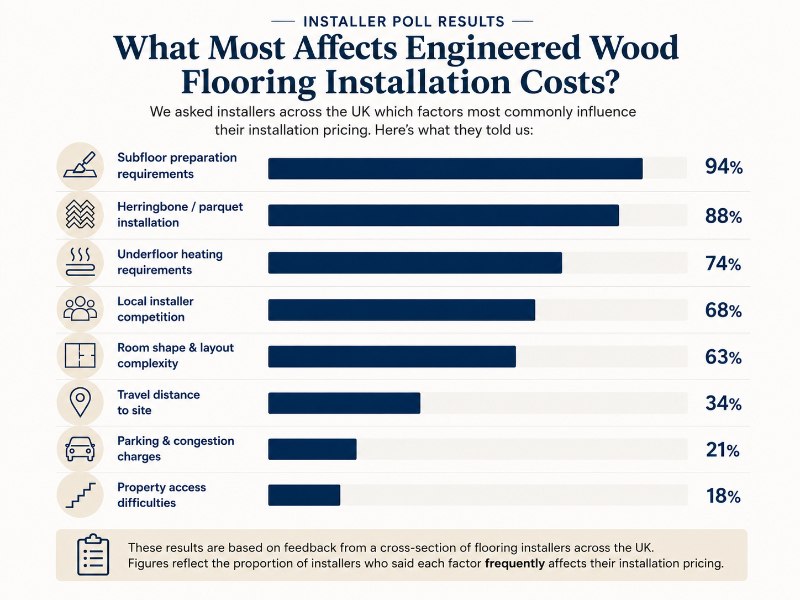
What UK Flooring Installers Say Affects Installation Cost
We spoke with a cross-section of flooring installers from across the UK to ask what most commonly affects their installation pricing.
Here’s what they told us: –
Subfloor Preparation Was By Far The Biggest Pricing Factor
Almost every installer we spoke with highlighted subfloor preparation as one of the biggest factors affecting installation costs.
Uneven screeds, damaged timber subfloors, old adhesive residue, moisture issues and levelling requirements can all significantly increase labour time before installation even begins.
Many installers noted that customers often focus heavily on the flooring itself, while underestimating the importance of proper preparation work beneath the surface.
Herringbone & Parquet Significantly Increase Labour Time
Installers consistently reported that herringbone and parquet installations require considerably more cutting, planning, adhesive work and layout precision than standard straight plank installations.
This additional labour is one of the main reasons herringbone engineered wood flooring typically commands much higher installation rates per m².
Underfloor Heating Adds Complexity
A large proportion of installers also said underfloor heating systems can increase installation complexity, particularly where moisture testing, expansion allowances and adhesive specifications are concerned.
In many cases, installers stressed the importance of using flooring specifically designed for underfloor heating compatibility.
| Factors Affecting Installation Cost | Installers Who Said It Impacts Pricing |
|---|---|
| Subfloor preparation requirements | 94% |
| Herringbone / Parquet installation | 88% |
| Underfloor heating requirements | 74% |
| Local competition | 68% |
| Room shape / complexity | 63% |
| Travel distance | 34% |
| Parking / congestion charges | 21% |
| Property access issues | 18% |
Our Expert Advice Before Installing Engineered Wood Flooring
Having worked with engineered wood flooring for over two decades, we know how important the installation process is.
A high-quality engineered wood floor will last for decades, so long as it is installed correctly. Below are some of the most important things we believe homeowners should consider before installation begins.
1. Do Not Underestimate The Importance Of Subfloor Preparation
In our experience, subfloor preparation is one of the biggest factors separating a premium-feeling installation from a disappointing one.
Even the highest quality engineered wood flooring can develop:
- movement
- creaking
- uneven joints
- flexing
- or visible gaps
…if the subfloor underneath is not properly prepared.
A good installer will always check:
- moisture levels
- subfloor flatness
- structural stability
- and overall site conditions
before installation begins.
Many homeowners understandably focus most of their attention on the flooring itself, but the condition of the surface beneath the floor often has an even bigger impact on how the finished installation feels underfoot.
2. Cheap Installation Often Becomes Expensive Later
Flooring installation is one of those areas where choosing purely on price can sometimes become very costly in the long run.
Poor installation can lead to:
- movement and lifting
- visible gapping
- broken joints
- adhesive failure
- excessive wastage
- and premature wear
A well-installed floor should look balanced, clean and consistent across the entire room, with carefully planned board layouts and neat finishing details around edges, doorways and transitions.
3. Think Carefully About Board Quality — Not Just Colour
A lot of homeowners understandably shop visually first. They find a colour or style they love and then compare prices.
But with engineered wood flooring, there can be major differences beneath the surface.
Board quality affects:
- installation speed
- long-term stability
- joint durability
- repairability
- and the overall visual finish of the floor
Trust us, a premium quality engineered wood floor will save you money on installation costs and deliver a return on your investment for many years to come, because: –
- the boards fit together more accurately
- the finish is more consistent
- the floor feels more solid underfoot
- and the final result looks calmer and more architectural overall
4. Herringbone Floors Require More Planning & Precision
Herringbone engineered wood flooring can look absolutely stunning, but it is important to understand that it is a more labour-intensive installation.
Compared to straight plank flooring, herringbone layouts involve:
- significantly more cutting
- much more layout planning
- higher wastage
- more adhesive work
- and greater installation precision
Hence why herringbone installation costs are usually higher.
5. Underfloor Heating Compatibility Matters
One of the biggest advantages of engineered wood flooring over solid wood is its suitability for underfloor heating.
However, not all engineered wood flooring performs equally well with UFH systems.
The stability of the board construction, wear layer thickness and locking system all play an important role in how the floor responds to ongoing temperature changes.
We strongly recommend:
- using engineered wood flooring specifically approved for underfloor heating
- following the manufacturer’s temperature guidelines
- and ensuring the heating system is properly commissioned before installation
A stable floor combined with gradual temperature changes is usually the key to long-term performance.
6. A Great Floor Should Still Look Great In 30 Years
One of the reasons we are so passionate about high-quality engineered wood flooring is because a properly chosen and properly installed floor can completely transform how a home feels for decades.
A good floor becomes part of the architecture of the property itself.
It is something you see, walk on and experience every single day.
Don’t just focus on the m2 cost, consider:
- long-term durability
- repairability
- stability
- finish quality
- and timeless design
Because those are the things that ultimately determine whether a floor still looks exceptional many years later.
FAQs
Engineered wood flooring installation typically costs between £25 and £60 per m² for labour, depending on the installation method, room layout, subfloor condition and region. Herringbone, parquet and glue-down installations usually cost more than standard floating installations.
Installation costs vary because every project is different. The biggest factors are usually subfloor preparation, installation method, board quality, room shape, underfloor heating requirements and whether the floor is being fitted in a straight plank, herringbone or parquet pattern.
Yes, floating installations are usually cheaper because the boards click together over an underlay rather than being glued or nailed down. This makes the installation quicker and generally less labour-intensive.
Herringbone flooring is more expensive to install because it requires more cutting, more planning, more adhesive work and greater precision than standard straight plank flooring. It also usually creates more wastage.
Floating engineered wood flooring usually requires underlay. Glue-down engineered wood flooring does not use traditional underlay because the boards are bonded directly to the subfloor using adhesive.
Yes, many engineered wood floors are suitable for underfloor heating, provided the flooring is approved for UFH use and the manufacturer’s installation guidance is followed. Engineered wood is generally more stable than solid wood, making it a popular choice for heated floors.
Yes, subfloor condition can have a major impact on installation cost. Uneven, damp or damaged subfloors may need levelling, moisture protection or repair work before the flooring can be fitted properly.
Yes, engineered wood flooring is typically cheaper and easier to install than solid wood, especially when using modern click systems. It is also more stable and better suited to modern homes and underfloor heating.
A straightforward engineered wood flooring installation may take one to three days, depending on the size of the room. Larger areas, subfloor preparation, glue-down fitting and herringbone layouts can take significantly longer.


